
The CFO forwards the March invoice with one line attached: Why are there 14 line items?
You recognize four. LAX, March 3. Newport Beach to Irvine, March 11. Then "wait time — 0.75," "after hours," "fuel," and $64 nobody can explain. Nobody can tell you whether the company got what it paid for.
A corporate car service account is a standing agreement with a licensed chauffeured operator: rates fixed before you travel, a named list of people who can book, one consolidated invoice a month. Three things decide whether it works: how the rate is structured, how the billing trail is built, and how you vet the operator. We run corporate transportation in Orange County, so weigh that. Most of this is the list of questions every assistant should ask, including where the answer is "use Uber."
What a corporate car service account actually is
A corporate car service account is a standing booking and billing agreement with a licensed chauffeured operator. It fixes rates before you travel, names who may book, and rolls every trip into one monthly invoice with a cost center attached. You are buying predictability, not a discount.
Four things come with a real one:
- A rate sheet. Flat prices for the routes you run, plus an hourly rate for standby days.
- Authorized bookers. One assistant or a short list. Everyone else gets quoted. Ask how they book: an email, a phone call, or a portal, and which one works at 4am.
- Cost centers, captured at booking so finance can split the bill without emailing you in April.
- One itemized invoice, with a named person to send it back to.
What varies: wait time, the cancellation window, whether gratuity sits inside the rate, and who pays tolls and airport fees. Pin those down in writing. They rarely are, which is how a $64 charge appears in March.
How corporate car service billing should work
Two models, and the wrong one on the wrong trip is where budgets leak.
Per-trip flat rate. One price, door to door, agreed before the car moves. Traffic doesn't change it. Right for airport transfers.
Hourly. The car and driver are yours for a block, usually with a three or four hour minimum. Right for a day of stops, wrong for a 25-minute drive to lunch.
| Booking | Price it by | Because |
|---|---|---|
| LAX or SNA transfer | Flat, per trip | The price shouldn't move when the 405 doesn't |
| Office to client, one stop | Flat, per trip | Hourly minimums triple a short hop |
| Four meetings in a day | Hourly | You're buying availability, not miles |
A flat LAX transfer in the SUV class runs about $185 to $275 from north and central Orange County, and $200 to $290 from Newport Beach and the coast, before gratuity. Our breakdown of what a private transfer costs is the number to check a quote against.
Ask what the monthly report shows. Trips, wait time, on-time arrivals, cancellations. A provider who can't produce that is running retail bookings with a monthly total.
Reconcile against five things: passenger and booker, date and both addresses, vehicle class and base rate, gratuity and fees on their own lines, and the PO printed. A provider who can't produce that is running retail bookings with a monthly total.
What should never surprise you: an after-hours fee, fuel, or gratuity appearing first at invoice stage. All are legitimate ways to price a trip. None are legitimate surprises.
The vetting questions that actually matter
License. California regulates chauffeured vehicles under charter-party carrier rules, and operating one requires authority from the CPUC. The commission's transportation pages explain the categories; the public carrier search on TCPortal shows a company's permit and insurance status. Ask for the TCP number. "Fully licensed and insured" is a phrase, not a number.
Insurance. Insurance is a condition of holding that authority, and the CPUC publishes the filing requirements. You need the certificate of insurance, checked against procurement's requirements, before the first trip.
Driver screening. Ask what is checked and how often: driving record, background, drug and alcohol testing. Then whether the same drivers serve the account or whoever is free at 5am.
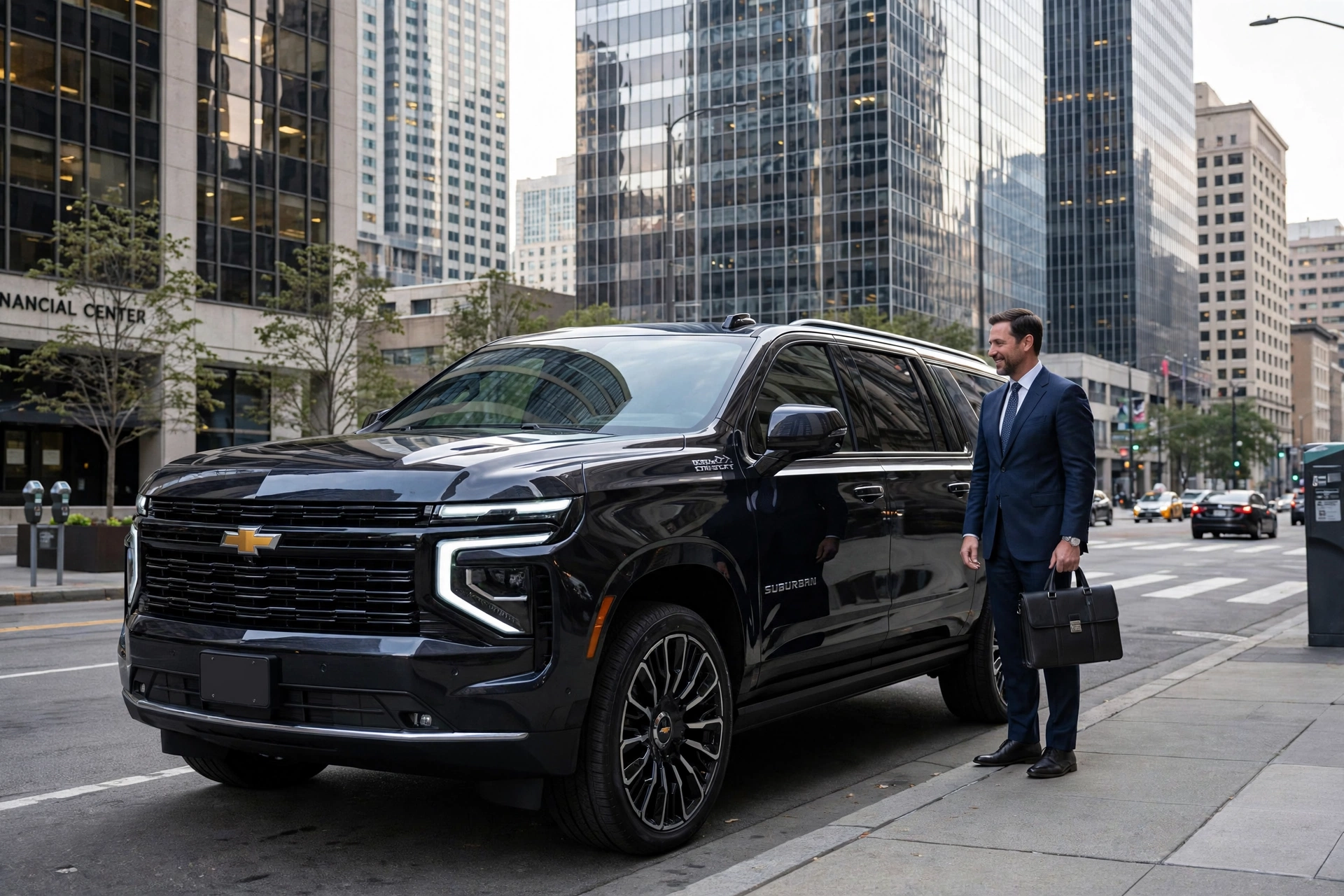
The vehicle. Whether the car quoted is the car that arrives. Every MJ Limos booking is the Suburban we run, a 2026 model with six seats and four to six suitcases. No upgrade lottery.
Breakdown cover. A car fails at 5:15am and the flight leaves at 8. What happens next? A real operator describes a process. A broker describes a promise.
Airport coverage. LAX, John Wayne, Long Beach, Ontario and Burbank, plus the private FBO terminals at each. If the program touches four of those in a month, that list is the first thing to check against a quote.
Airport runs for executives: the part that goes wrong
The arithmetic is boring and it's the whole job. From most of Orange County, leave about three hours before a domestic departure: two hours in the terminal, 45 to 95 minutes driving, 10 to 15 for the LAX loop. Our post on what time to leave for LAX does the sums city by city. International adds an hour.
Three things turn that into a service, and our airport transfers and John Wayne pickups are built around them.
Tracking that changes the pickup. The useful question is what happens when a flight moves. Lands 90 minutes early, does the car move up? Lands four hours late, who decides whether the driver waits? Get the wait policy in writing.
Meet and greet, defined. A driver inside the terminal, past security, with a name and a phone that answers. Not a text saying "outside door 4." Ask whether it's included.
The LAX-it difference. Rideshare and taxi pickups happen at LAX-it, a lot beside Terminal 1 reached by shuttle. Chauffeured cars still collect arriving passengers at the curb, which is how LAX's own guidance draws the line. Departures are unaffected. At 11pm on arrival, it's walking to a car versus hauling a bag onto a shuttle. Confirm before relying on it.
An Uber receipt isn't the same service. No name on a sign, no fixed price, nobody to call when the driver cancels, nothing saying which client the trip served.
Roadshows and multi-stop days
A roadshow is a scheduling problem wearing a transport costume. Price it by the hour and build the day backwards from the last meeting.
Four stops from Newport Beach to Laguna: roughly five hours of driving, an hour of walking-in time at 15 minutes a stop, and 20 minutes for the thing nobody planned. Six and a half hours of vehicle time, which is $715 to $975 before gratuity at the $110 to $150 hourly rates above.
Separate flat bookings can come in lower, right up until the third meeting overruns and the fourth car is outside on the clock. On a day with a hard finish, hourly beats improvisation.
Buffer math. Add 15 minutes at every stop, not five. A badge desk, an elevator and someone who left a laptop upstairs eat more time than the drive. Two stops more than 20 miles apart between 3pm and 7pm? Add 20 minutes.
When two cars beat one. Our Suburban seats six, so a seven-person roadshow is two vehicles. Arithmetic, not a sales pitch. The other case is a split: two executives in different cities at the same hour. Reshuffling one car costs more in goodwill than the second vehicle costs in dollars.
Uber for Business vs a local car service
Uber for Business is a real product and worth using. It centralizes rides onto a company account, sets policy controls and budgets, allows delegate booking for assistants, and consolidates billing per trip or monthly on one receipt. It integrates with Concur, Expensify, Ramp and Navan, and signup is free.
| Situation | App | Car service |
|---|---|---|
| One employee, short notice, no luggage | App | Overkill |
| Airport arrival with four bags | Risky | Booked car |
| Six people to one meeting | Two cars, two receipts | One Suburban |
| 5:30am with a hard deadline | Supply gamble | Confirmed driver |
Where it breaks:
- Surge. A fixed budget meets a variable price. Convention weeks in Anaheim are the local version.
- The 4am no-show. Supply is thin before sunrise. A scheduled ride lowers the risk, but no specific car is guaranteed.
- No meet and greet. Nobody is inside arrivals. For a visiting board member, that's the entire experience.
- Reconciliation. "Uber, $47.19" tells finance nothing about which meeting it served. Multiply by 40 and you have March again, in a different font.
Most companies end up with both, and a rule: fixed time, luggage, more than two people, or a client on board goes to the car service.
Setting up an account in a week
- Day 1. Three months of spend, ten routes that repeat. That list is your negotiating document.
- Day 2. Shortlist two operators, both checked on the CPUC carrier search.
- Day 3. Rate sheet, sample invoice, certificate of insurance, wait-time and cancellation terms.
- Day 4. Put both quotes against your ten routes and read the two sample invoices side by side. The one you can reconcile in five minutes is the one to sign.
- Day 5. Agree in writing: bookers, cost center format, invoice date, payment terms, escalation contact.
- Next week. One airport transfer, one multi-stop day. Read the invoice against the booking.
No procurement software, no RFP. A week now saves the CFO's email in March.
Frequently Asked Questions
Roughly $185 to $275 for a flat SUV transfer to or from LAX before gratuity, and $110 to $150 an hour for multi-stop work with a three to four hour minimum.
Transportation that is ordinary and necessary for business is generally deductible; commuting to your regular workplace isn't. The IRS covers the distinction in Publication 463. Your company deducts the trip; an employee generally can't. Ask your accountant; this isn't tax advice.
Yes. Chauffeured vehicles fall under the CPUC's charter-party carrier rules, and a company needs operating authority before carrying passengers for hire. Verify any operator on the CPUC's public carrier search.
Yes, if nobody has more than a suitcase each. The Suburban seats six with room for four to six suitcases. Seven passengers means two vehicles, so price that at quote stage.
Two to three weeks for transfers and single meetings, three or more for multi-stop days and Anaheim convention weeks. Dawn departures need the most notice; there is no fallback car at 4am.
Get the account sorted
If you're the person who was handed this, send the ten routes you actually run and we'll put flat rates against them, plus a sample invoice for finance. Every ride is a 2026 Chevy Suburban, flight tracked, and Nuna car seats free.
Request a quote or call (714) 936-5055. If Uber for Business is the better answer for part of your program, we'll say so.